
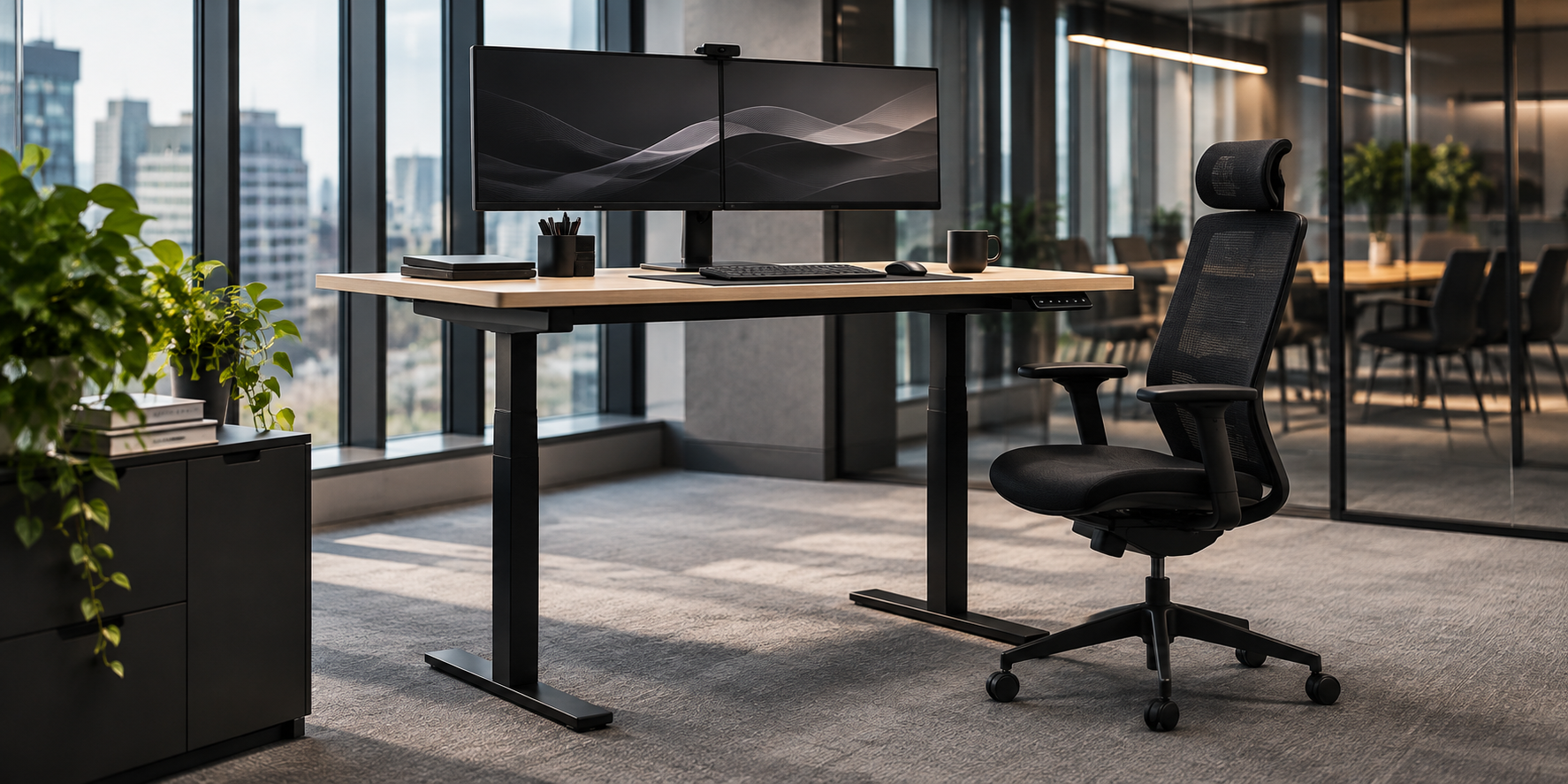
Office furniture is usually bought on price and looks. But the desk is where your team spends most of its working day, and that makes it one of the most direct wellbeing tools a business owns. For HR managers, facilities teams and co-working operators, sit-stand desks have moved from a perk to a serious fit-out option.
Here’s the business case, based on published trials rather than sales talk.
The problem: offices are built for sitting
Office workers are one of the most sedentary groups in the workforce, spending 70–85% of their time at work seated. Traditional fixed desks give people no easy way to change that. Breaks, walking meetings and reminders help a little, but the evidence shows the environment matters most.
What the trials found
Sitting drops, and stays down. In a 12-month trial of 146 NHS office staff published in The BMJ, sit-stand desks combined with brief guidance cut sitting by more than an hour a day. The reduction held at the 12-month mark.
The desk is the multiplier. A 2022 trial of 756 desk-based council employees in Leicester, Liverpool and Greater Manchester compared a support programme on its own with the same programme plus height-adjustable desks. Adding the desk made the programme about three times more effective at reducing sitting.
Work outcomes moved too. In the 12-month trial, the sit-stand group reported better job performance and work engagement, plus less occupational fatigue, less sickness presenteeism (coming to work unwell) and lower daily anxiety than the control group.
No productivity penalty. A Cochrane review covering 34 studies found that standing more did not reduce productivity or cause harms such as musculoskeletal pain.
What this means for your business
- Wellbeing you can see: a sit-stand desk is a visible, daily signal that the business takes staff health seriously, which supports retention and recruitment.
- One desk, many users: in hot-desking and hybrid offices, height adjustment means every user gets a correct setup at a 62–127 cm range, with no extra furniture.
- Future-proof fit-outs: a 5-year structural warranty and 120 kg load rating mean the desks survive moves, monitor upgrades and years of daily use.
- A selling point for co-working spaces: premium members expect premium workstations. Sit-stand desks justify higher-tier memberships and dedicated-desk pricing.
How to roll out sit-stand desks successfully
The trials show that desks work best with a little support. Use these steps:
- Start with a pilot team. Give one department desks for a month and collect feedback before a full roll-out.
- Appoint a champion. The 2022 trial used workplace champions to encourage new habits. One enthusiastic person per team makes a difference.
- Share simple targets. Encourage switching position every 30–60 minutes, not standing all day.
- Complete the workstation. Pair desks with adjustable chairs, monitor arms and anti-fatigue mats so both sitting and standing are comfortable.
- Show people how. A five-minute setup session on desk height and screen position avoids poor habits from day one.
Keep expectations realistic
Researchers are clear that long-term health benefits are still being studied, and that the quality of much of the evidence is limited. The case is strongest for what the trials measured directly: less sitting, better engagement and no loss of output. For most businesses, that is enough to justify the investment.
FAQ
Do standing desks improve productivity? Trials found no drop in productivity, and one 12-month trial found self-reported job performance and engagement improved.
Are sit-stand desks suitable for hot-desking? Yes. Height adjustment and memory presets let each user set the correct position in seconds.
Can ARORA supply desks for a full office? Yes. Speak to us about bundle pricing for teams, offices and co-working spaces.
CTA: Planning an office fit-out? Explore ARORA Team Office solutions or email us for a bulk quote.
Sources: SMArT Work trial, The BMJ (2018) · BMJ press release on SMArT Work · SMART Work & Life trial, The BMJ (2022) · Cochrane review summary

